



As universities nationwide report declining lecture attendance, Bristol is doubling down on in-person provision with the UK’s first lecture theatre “in the round”. Featuring six circular seating rows surrounding the lecturer, it forms part of the new Temple Quarter Enterprise Campus (TQEC). Opening in September 2026, the 38,000 sq m building — accommodating 4,600 students and 650 staff next to Temple Meads station — becomes the university’s hub for digital, business and social innovation, complete with cyber rooms, a Bloomberg trading floor and a makerspace.
This flagship campus represents significant news for this long-established university, much of which occupies historic Georgian buildings on tree-lined streets. In a nod to heritage, a new gallery showcases its Cultural Collections spanning art, archives and museum-quality holdings.
For school-leavers, Bristol's city life is as compelling as its research-led academics. First-year accommodation ranges from traditional halls such as Stoke Bishop's Wills Hall — boasting catered gowned dinners and tennis courts — to city-centre options such as Campbell House, equipped with a cinema, karaoke rooms and gym. Unsurprisingly, Ucas and Knight Frank research reveals nearly half of graduates choose to remain in the city after graduation.

What is the University of Bristol’s academic reputation?
Upon its 1876 founding as University College Bristol, it was the first higher education institute in England to admit women. The university delivered an outstanding REF 2021 performance, with 94 per cent of research across 1,500 eligible staff and 28 disciplines rated world-leading or internationally excellent. Standout areas included engineering, medicine, law, chemistry, geography, dentistry, modern languages, natural sciences, social policy and social work, placing Bristol sixth in our research quality index.
Despite losing six places in the QS World University Rankings year-on-year, Bristol was rated 57th globally (and eighth in the UK) in the 2027 edition. In our main academic rankings it has maintained its top ten position.
In TEF 2023, Bristol achieved silver overall and for student experience, alongside gold for graduate outcomes. Its computing capability surged with the 2025 launch of Isambard-AI — a £225 million facility rated the world’s fastest university-based supercomputer.
Global links with more than 150 institutions — including the University of Copenhagen, the National University of Singapore and the University of California — create study-abroad semesters, exchange years and funded summer programmes. Environmentally, Bristol climbed to joint 23rd in the People & Planet league (third among Russell Group peers).
Seven new courses launching in 2026 include a BA in economics, a BSc in economics and data science, and an international foundation programme for medicine (a one-year pathway bridging overseas qualifications for UK medical degrees).
What are the University of Bristol’s entry requirements — and my chances of getting in?
Demand reached record highs for 2025 entry, when applications passed 65,000 for the first time and undergraduate acceptances exceeded 8,000. Over the past decade, international applications have outpaced domestic growth — a scale of expansion matched by few Russell Group peers after the lifting of recruitment caps more than a decade ago.
Standard requirements span A*A*A at the top end down to BBC. Standards are high, but Bristol is also a pioneer of contextual offers: eligible students may receive offers one or two grades lower than standard across most courses, accounting for roughly 37 per cent of offers in 2025.
What are the graduate prospects and how will the university help me get career-ready?
A Bristol degree carries substantial weight in the job market — the university was the sixth most targeted institution by top employers in the 2025-26 High Fliers report. The university remains in our top 20 for graduate prospects (19th). In the Graduate Outcomes survey, our analysis showed that 79.4 of leavers had found highly skilled jobs or returned to further study 15 months after finishing their degree.
What is the University of Bristol’s campus like?
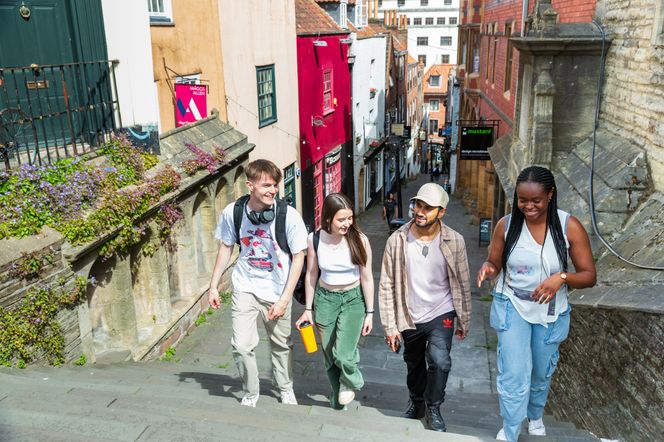
On the main Clifton campus, Georgian buildings are set against the green spaces of the Downs and the Avon Gorge, straddled by the eye-catching Clifton Suspension Bridge. Bristol’s neogothic Wills Memorial Building spire, where graduates collect their scrolls, has commanded the skyline since 1925. Eight of the university’s nine libraries are at Clifton, including one with late opening hours in the Wills Memorial Building. The Richmond Building houses the students’ union, two theatres and a leading city music venue.
Alongside TQEC, other recent standout facilities include the £56.5 million Life Sciences building, featuring chemistry laboratories certified as a Centre for Excellence in Teaching and Learning.
Off campus, a new teaching block at Langford boosts veterinary provision, while the Arts and Social Sciences library offers 3D printers, Meta Quest VR headsets and laser scanners on loan. The dental school occupies purpose-designed premises on Avon Street, and the university maintains a 4,500-species botanic garden in Stoke Bishop.
When can I visit?
Everything you need to know about the University of Bristol’s student life and wellbeing support
The students’ union offers more than 300 student-run societies, sports clubs and support networks, covering everything from baking and hot-air ballooning to free-speech groups. Bristol’s nightlife offers something for everyone — from pubs serving the area’s speciality, cider, to nightclubs attracting big-name drum ’n’ bass and jungle DJs.
Bristol sports teams placed ninth in the 2025-26 Bucs overall points table (up from tenth the year before). The Indoor Sports Centre at the heart of the campus includes two gyms, a sports hall, an indoor running track, a sports medicine clinic and a nearby swimming pool. In Stoke Bishop, north of the main campus, is the 38-acre Coombe Dingle sports complex — the site for most training and competition — while the university boathouse sits at Saltford on the River Avon.
Self-booking appointments make accessing wellbeing support straightforward. Mental health nurses are stationed at the university GP surgery, while the Residential Wellbeing Service operates year-round with a night team assisting students in halls and off-campus via phone.
What do the students say?
“My favourite aspect of the course was the practical component. Bristol has it all: socials, academics and opportunities to find your true self, and there are opportunities to work part time while studying.”
Shannon, BEng engineering mathematics
What about student accommodation in the University of Bristol?
With 9,420 study rooms, Bristol guarantees accommodation to first-years who apply by the end of June. Halls range from the traditional Wills Hall in North village with catered gowned dinners and tennis courts, to Campbell House in the city centre with its cinema and karaoke rooms and gym. Allocation is based on preferences and accessibility needs. Off campus, a room in houseshare close to the Clifton site or the centre costs between £600 and upwards of £900 a month, excluding bills. Bristol has revoked the free U1 bus pass scheme that used to be included in rent, meaning that from September 2026, first-year students living in university accommodation — including those in the North Village (Stoke Bishop) — will have to pay for an equivalent pass, which costs £436.50 a year, factoring in the 10 per cent student discount.
How diverse and inclusive is the University of Bristol?
Efforts to diversify intake include gateway programmes for medicine, dentistry and veterinary science appealing to underrepresented or disadvantaged groups, with entry criteria lower than contextual offers. Outreach activities include the Schools Engagement Strategy, supporting low-progression schools, and the Advancing Access partnership — helping teachers guide underrepresented students toward Russell Group universities.
The university has made modest gains in our social inclusion index in recent years and rises five places to 105= this year.
What financial assistance is available?
Bristol maintains a generous bursary scheme: about three in ten of the intake qualifies for a financial award. Around 4,000 students from households with income below £50,000 receive bursaries up to £2,500 per year of study. The Vice-Chancellor’s Scholarship awards up to £150,000 in a year to 30–40 students demonstrating exceptional talent in sport, music, or performing arts. The Futures Scholarship provides £400,000 each year to several hundred students to support employability, regardless of financial background. Think Big Scholarships for international students offer individual fee-waivers of up to £26,000 per year.


